In the fall of 2024 my cousin Harini called me from India. She had a job offer in Austin in healthcare and a flight booked for a few months later. She asked me one simple question. How much money do I need before I land. I did not have a clean answer ready, even after four years of living here myself. So we sat down over a few calls and actually built her a real number, piece by piece, the same way nobody built one for me back in 2020. This is that whole conversation written out.
Harini and I are close in a way that surprises some people, since she is my cousin not my sister, but we grew up close enough that it feels the same. When she called me that evening, her voice had that mix of excited and scared that I remembered from my own first weeks planning this same move.
She said the recruiter had told her the salary, told her Austin was a good city, and basically left it there. Nobody had told her what she actually needed in her bank account before she got on the plane.
I told her honestly, I made up a number back in 2020 and got it wrong. So this time we were not going to make one up. We were going to build it for real.
We Started With the Big One. The Deposit and First Month.
Harini did not have a job lined up yet that would start the moment she landed. There was a gap, about three weeks, before her position officially began. So her very first cost was rent without a paycheck yet to cover it.
I told her to expect first month’s rent plus a security deposit before she even got keys. For a one-bedroom in a reasonable Austin area, that meant somewhere around $1,300 for rent and another $1,300 to $1,600 for the deposit, since she would have zero US credit history the same way I did. No way around that. New people always pay more here until they build a record.


So just to walk in the door, she needed roughly $2,600 to $2,900 sitting in an account before her first paycheck ever arrived.
Then We Talked About the Application Fee, Which She Had Not Even Thought About
This part she genuinely did not know existed. I told her every apartment she applies to charges a fee just to run a background and credit check, usually $50 to $100, and you do not get it back even if they say no.
She asked if she should just apply to one place to save money. I told her that’s a real trade-off. Apply to one and you risk losing weeks if they reject you. Apply to two or three and you might burn $150 to $300 on fees for places you never move into. There is no perfect answer here. I told her to budget for two applications just in case, so add another $100 to $200 to the number.
We Got to Utilities and I Could Tell She Was Starting to Feel Overwhelmed
I remember her getting quiet on the call at this point. I told her that’s normal, I felt the same way the first time someone walked me through all of this, except nobody walked me through it, I just found out the hard way over several months.
Electricity in Austin needs a deposit too if you have no credit history, usually around $200. Internet is another $35 to $70 depending on what is available at her address. Renters insurance is small, $10 to $15 a month, but it is required and it is one more thing to set up in the first week.
She asked if all of this had to happen on day one. I said no, but most of it happens in the first two weeks, so financially it might as well be day one.
Then We Actually Sat Down and Built the Real Number Together
This is where I want to be honest about something. I did not just hand her a clean number. We went back and forth on this call for a while, and I actually got one part wrong the first time through.
I told her first month plus deposit was $2,600. Then I remembered her deposit would likely be on the higher end since she had zero credit history, so I bumped that to closer to $2,900. Then she asked about the application fees again and I had forgotten to add those back in after we talked about utilities. We had to go back and re-add the $150 for two applications.
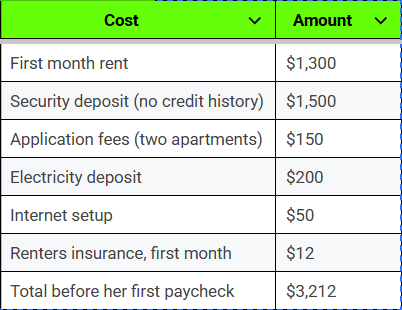
She said that number scared her a little. I told her it scared me too back in 2020, except I had never written it down, I had just felt the fear as each bill arrived one at a time over two months instead of seeing it all at once like this.
I Told Her to Add a Buffer, Because Something Always Goes Wrong
Sarah actually gave me this advice years ago and I passed it straight to Harini. Whatever number you build, add $300 to $500 on top for the thing you did not plan for. For me it was a locksmith bill after I locked myself out. For Harini I genuinely did not know what it would be, that’s the whole point of a buffer, you cannot predict the specific thing, just that something will happen.
So her real target became roughly $3,500 to $3,700 sitting in an account before her flight, not the $3,212 we had calculated from line items alone.
What Harini Actually Did With This Information
She told me later that having the number written out, even with us getting parts of it wrong along the way and fixing it together, felt completely different from just having a vague sense of dread about the cost. She said the vague worry was worse than the actual number, once she saw it clearly.
She landed in Austin in late 2024 with just over $3,600 saved. She told me a few months later that she came in almost exactly on budget, with maybe $80 left over after the chaotic first month, mostly because we had built in that buffer for the unexpected. Hers turned out to be a $60 charge for renters insurance setting up slightly higher than either of us had guessed, plus a small Uber bill from when her furniture delivery showed up a day early and she had to make an extra trip to a store.
If You Are Helping Someone Move to the US for the First Time
If you are in my position now, helping a cousin or a friend plan their first move here, do not just tell them a number off the top of your head the way the recruiter told Harini. Build it with them, line by line, the same slow way we did it. Let them see you get a number wrong and fix it. That process matters more than the final total, because it teaches them how to think about the next cost that nobody warns them about either.
FAQ
How much money should an international student or new worker save before moving to Austin?
A safe target is around $3,500 to $4,000 before you land, covering first month’s rent, a security deposit (which is often higher with no US credit history), application fees, utility deposits, and a buffer for unexpected costs.
Why is the security deposit higher for someone with no US credit history?
Landlords use credit history to judge how likely you are to pay rent on time. With no history here, they have no way to check that, so many landlords ask for a bigger deposit, sometimes 1.5 to 2 times the monthly rent instead of just one month.
Should I apply to more than one apartment if I am moving from another country?
It depends on your timeline. Applying to just one apartment is cheaper but risky if they say no and you have a tight move-in date. Applying to two or three costs more in fees, usually $100 to $300 total, but gives you more safety if one application falls through.
What costs show up in the first two weeks of a new apartment that people forget about?
Electricity deposits, internet setup fees, and the first month of renters insurance all tend to hit in the first two weeks. None of these are usually mentioned by a recruiter or employer, so they catch a lot of new arrivals off guard.
How big of a buffer should I add to my moving budget?
Add $300 to $500 beyond your planned costs. You will not know exactly what it covers ahead of time, that is the nature of a buffer, but something unexpected almost always shows up in the first month, whether it is a locksmith bill, a higher than expected insurance rate, or an extra delivery cost.
Is it better to get help from someone who already lives in the city before moving?
Yes, genuinely helpful if you can get it. Numbers that come from someone who actually lived through the costs are usually more accurate than estimates from a recruiter or a generic online guide, since real costs vary a lot by city and by your specific situation like credit history.