In 2022 I was spending around $2,700 a month and still feeling broke. In 2026 I spend a little more than that in total but I feel a lot less stressed about it. The numbers did not change as much as my understanding of them did. This post is a side by side look at exactly what I was spending in 2022 versus what I spend now, what surprised me when I compared them, and the one area where I am genuinely proud of how far I have come.
In June 2022, my salary started. In July 2022, my budget fell apart.
Not in a dramatic way. Nothing broke. I did not miss rent. But I had more money coming in than I had ever had before and I still felt like I was just about keeping my head above water every month. That did not make sense to me at the time. Now it does.
Four years of renting in Austin, three apartments, one wild market peak, and a lot of bad spending months in between have taught me things that no amount of advice could have. The only way I learned most of this was by getting it wrong first.
So here is the honest comparison. 2022 me versus 2026 me. Same city, same person, very different relationship with money.
First, the Market Context
Before the numbers, it helps to know what Austin was doing in those two years because the market shapes everything.
2022 was the peak. Rents had been climbing fast since 2021 and by mid-2022 landlords had all the power. Places were getting taken in hours. Prices that would have seemed impossible in 2020 were just normal by 2022. I wrote about how extreme that gap was in my post comparing Austin rent costs in 2026 vs 2022, which shows just how much the market moved in those four years.
2026 is softer. A lot of new buildings came up between 2023 and 2025 and that extra supply helped bring prices down from their peak. Not back to 2020 levels, nowhere near that, but meaningfully lower than the top. Renters have a bit more power now than they did in 2022 and that shows up in my budget in ways I will get into.
The Side by Side Numbers
Here is what my monthly spending actually looked like in both years. The 2022 numbers are from my East Sixth Street one-bedroom. The 2026 numbers are from my current one-bedroom in the Mueller area.
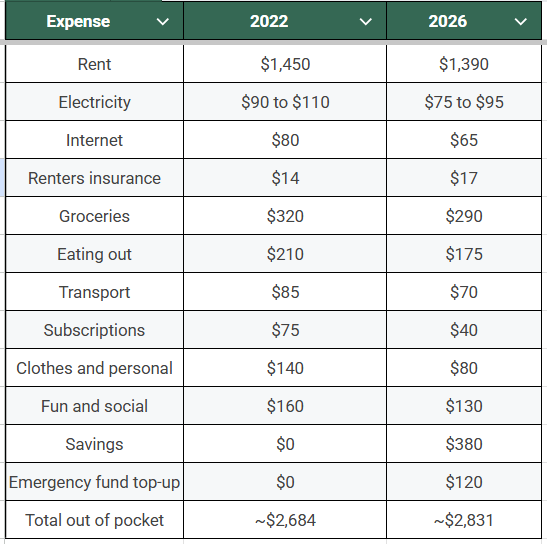
Wait. I spend more in 2026 than in 2022? Let me explain that because it looks wrong at first.
The total is higher in 2026 but $500 of that is money going into savings and my emergency fund. In 2022 that line was zero. So if I strip savings out and compare just spending, 2026 me spends about $2,331 a month on actual life costs versus $2,684 in 2022. That is $353 less per month going out the door on real expenses, while also putting $500 away.
That gap happened in the categories I actually had control over. Not rent. Not utilities. The stuff I was choosing to spend on.
What Went Down and Why
Subscriptions dropped from $75 to $40. In 2022 I had signed up for things I barely used because I finally had money and said yes to everything. A meal kit service I used twice. A fitness app I opened for two weeks. A music plan I did not need because I already had the free version. I canceled them all eventually and got much more careful about what I actually let auto-renew. I wrote about this exact problem in my post on what first-time renters waste money on, because subscriptions were one of the biggest silent drains in that first year.
Clothes and personal spending dropped from $140 to $80. In 2022 I was buying things to feel like I had a real adult life. A nicer work bag. Better shoes. Things that felt important right after getting a job. Four years later I have those things and I do not need to keep buying them.
Eating out dropped from $210 to $175. Still higher than I would like honestly. But I got better at cooking in batches on Sundays which cuts down the number of nights I order food because I am too tired to cook something.
What Stayed Roughly the Same
Food and groceries stayed close. $320 in 2022, $290 now. Austin grocery prices have not changed much in my experience. The difference is mostly that I got better at not wasting food, which I wrote about in my post on what first-time renters waste money on in their first apartment. Buying for three or four days instead of a full week cut my food waste almost completely.
Transport stayed close too. I do not own a car. I use the bus, the occasional rideshare, and my bike for shorter distances. That has not changed much because my situation has not changed much.
Renters insurance went up slightly, from $14 to $17, because I added a little more coverage after I got more stuff worth protecting. Still one of the best $17 I spend every month. If you are still skipping this, my post on renters insurance in Austin explains exactly why it is worth it.
The Part I Am Most Proud Of
Zero to $500 a month in savings.
In 2022 I was saving nothing. Not because I could not, looking back, but because I had no system. I spent what came in and hoped things would be fine. They mostly were but there was a period around late 2022 where my laptop broke and I had nothing to cover it and I put it on a credit card and spent two months paying it off while also paying rent, and those two months were genuinely stressful in a way I do not want to repeat.
I started building my emergency fund properly in early 2023. Slow at first, $25 a transfer. Then $60. Now it is automatic and I do not think about it. The full story of how I built that habit is in my post on building an emergency fund when rent is high, which covers what actually worked versus what sounds good in theory.
Having that money sitting there changed how every month feels. A surprise bill does not ruin anything anymore. It is just a bill.
The One Thing That Did Not Improve Enough
Eating out. I said $175 a month like that is fine. It is not really fine. That is over $2,100 a year on food I could have made at home for maybe $600. I know this. I have known it for three years. I still do it because after a long day the last thing I want to do is cook.
I am not going to pretend I have solved this. Some budgeting problems you fix. Some you just manage. Eating out is mine that I manage imperfectly and probably will for a while.
What the 2022 Version of Me Got Wrong
The 2022 version of me thought having more money meant the money stuff would sort itself out. It does not. Money does not organize itself just because there is more of it. If anything, more money means more decisions and more chances to make bad ones.
The 2022 version of me also thought rent was the only number that mattered. If I could cover rent, everything else would be fine. That is not how it works. Rent is the biggest line but it is the subscriptions and the eating out and the random spending that quietly eat the rest.
If you are trying to figure out how much of your income should actually go to rent before you sign a lease, my post on how much income should go to rent has the number you should aim for and explains what happens when you go over it.
What Four Years Actually Taught Me
Budgets do not work because you are disciplined. They work because you set them up so you do not have to be disciplined. Automatic savings, canceled subscriptions you actually check, cooking in batches so you do not order food when tired. Systems beat willpower every time.
The other thing four years taught me is that the costs you control matter more than the costs you do not. Rent in Austin is what it is. Utilities are what they are. But subscriptions, eating out, random buying because you feel like you deserve something after a hard week, those are all choices. And choices compound over four years into a very real number.
2026 me is not perfect at this. But 2026 me is a lot better than 2022 me, and 2022 me was already doing better than 2020 me, so the direction is right even if the pace is slow.


FAQ
Did rent actually go down from 2022 to 2026 in Austin?
For me it did, from $1,450 to $1,390, but that is partly because I moved to a different apartment and got a better deal in a softer market, not because rents across Austin dropped everywhere. The market in 2026 is softer than 2022 but it is not cheap. Some areas are still close to 2022 prices. Others came down more. It depends heavily on the neighborhood and the building.
How did you manage to save $500 a month when you could not save anything in 2022?
Honestly the main thing that changed was making it automatic. I set up a transfer to a separate savings account on payday before I had a chance to spend the money. When I tried to save what was left at the end of the month in 2022, there was never anything left. Moving the money first and spending the rest fixed that completely.
Is it normal to feel broke even with a good salary?
Very normal and very frustrating. The reason it happens is that spending tends to grow with income without you deciding it should. You buy slightly better versions of things. You say yes to more. You get subscriptions. It adds up quietly until your bigger salary feels just as tight as the smaller one did. The fix is looking at where the money actually goes rather than assuming a bigger number means more comfort.
What was the single biggest waste in your 2022 budget?
Subscriptions and random buying in the first few months after starting my job. I signed up for things because I finally could and then forgot about them. That was about $400 to $500 in the first six months alone that I got basically nothing from. The moment I started actually checking what was auto-renewing, I cut that category almost in half.
Should I try to match the 30 percent rent rule even in an expensive city like Austin?
Try to, yes. It is not always possible, especially when you first move to Austin and the market is what it is. But knowing the rule helps you understand what you are giving up when you go over it. Every percent above 30 that goes to rent is a percent that cannot go to savings, food, or anything else. The rule exists because the math works out badly above it over time.
How different does Austin feel to rent in now versus 2022?
A lot less panicked. In 2022 you had to move fast on everything and even then you might lose a place to someone who offered more. Now there is more time to look, more places to choose from, and landlords are more willing to negotiate or throw in a free month. It is still not a cheap city but the power has shifted a little back toward renters compared to where it was at the peak.