In early 2025 my company told me there was a strong chance I would be relocating to our Denver office within two months. I believed it enough that I gave my landlord notice and started looking for a way out of my East Sixth lease, which still had seven months left on it. Then the relocation fell through at the very last minute. I was stuck having already started the termination process, with fees already in motion, for a move that never happened. This is the actual math of what that cost me and what I learned about how lease termination really works in Texas.
I want to back up a little because the order of events here matters.
Ranjith had moved back to India in mid-2024 after finishing his degree. I signed a new lease on the same East Sixth apartment in January 2024 while he was still there, and after he left I just stayed on alone, paying the full $1,380 myself instead of splitting it. That lease ran through December 2025.
Then in February 2025, my manager pulled me into a one on one and mentioned, almost casually, that the company was considering moving a chunk of our team to the Denver office. He said it was not finalized but it was likely enough that I should start thinking about it. I remember sitting in that meeting room afterward just staring at my laptop screen, not really processing what I had just heard.
I called my mom that night. I texted Sarah the next morning. Everyone said basically the same thing. If it is likely, start preparing now so you are not scrambling later.
So I started preparing. I emailed my landlord in late February explaining the situation and asking what early termination would actually involve.
What My Lease Said About Breaking It Early
My lease had an early termination clause, which most Austin leases do. It said I could end the lease early by paying an early termination fee equal to two months rent, which in my case was $2,760, plus I would forfeit my $1,380 security deposit. So the total cost of walking away clean was $4,140.
There was also an alternative option in the lease. I could continue paying rent until the landlord found a replacement tenant, at which point my obligation would end. This is sometimes called a re-letting clause. The landlord is legally required in Texas to make a reasonable effort to re-rent the unit rather than just collecting rent from you while sitting on an empty apartment.
I did not know that second option existed until I actually read the early termination section carefully, which I am embarrassed to admit I had skimmed when I signed back in January 2024.


What I Actually Did
I told my landlord I was looking at a possible job relocation and asked which option made more sense given the timeline. She said if I gave 60 days notice she would start advertising the unit immediately and try to find a replacement tenant, and if she found one before my official move-out date, my financial responsibility would end the day the new tenant’s lease started.
That felt like the smarter path. So in early March I gave formal 60 day notice, which set my planned move-out date for early May 2025. The relocation, if it happened, was supposed to be finalized by April.
The landlord listed the apartment within a week. I remember walking past my own front door one evening and seeing a for rent sign in the window, which felt strange in a way I had not expected. Like watching someone advertise your own life while you are still standing in it.
By late March she had a new tenant lined up, someone who wanted to move in May 1st. Everything was lining up.
Then on April 10th my manager called me again. The Denver move was off. Budget changes at the company level, nothing to do with my performance, just a decision made above everyone’s head. I was staying in Austin.
The Problem With Timing
Here is where it got financially messy. I had already given notice. The landlord had already secured a new tenant for May 1st. I could not exactly call her up and say never mind, I am staying, because she had already promised that apartment to someone else.
I asked if I could stay in the unit past my notice date since the relocation fell through. She said the new tenant’s lease was already signed and she could not back out of that commitment, which was completely fair from her side. She was just doing what I had asked her to do when I gave notice.
So I had to actually move out on May 1st. Except now I needed a new apartment in Austin, in a market that, while softer than the 2022 peak, was still not cheap, and I needed it fast since I had about three weeks to find something.
What This Actually Cost Me
Let me walk through this honestly because the numbers got complicated in a way I had not expected when I first asked about early termination fees back in February.
I did not pay the $2,760 early termination fee or lose my deposit, since the landlord found a replacement tenant through the re-letting process instead. That part actually worked the way it was supposed to. I got my $1,380 deposit back in full once the move-out inspection cleared, minus about $40 for a small wall scuff near my desk.
But I still had to move. And moving has its own costs that had nothing to do with the lease termination clause itself.
I rented a moving truck for $140. I paid a new application fee on the Mueller apartment I found, which was $85. I paid a new security deposit there, which was $1,310, the full month’s rent since I had decent credit by that point and did not get the new-tenant surcharge I had paid back in 2020. I paid a new admin fee of $175.
Let me add this up because I genuinely did not do this math carefully in the moment, I just kept paying things as they came.
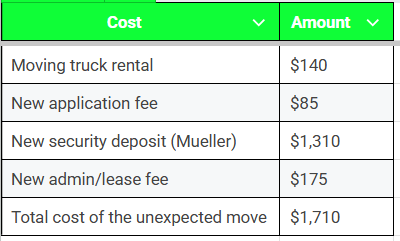
Wait, actually, let me redo that, because the security deposit is not really a cost the same way the others are. I got that money back eventually too, the day I move out of Mueller, whenever that ends up being. So the real out of pocket cost that was just gone, not coming back, was the truck, the application fee, and the admin fee. That is $140 plus $85 plus $175, which comes to $400.
Four hundred dollars for a move I never wanted to make, caused entirely by a relocation that never happened. The deposit is just sitting with my new landlord the same way deposits always are, not actually lost.
What I Would Do Differently
Sarah asked me afterward why I gave notice before the relocation was actually confirmed. Fair question. I told her my manager had made it sound close enough to certain that waiting felt risky in the other direction, like I would end up scrambling to find Denver housing with no time at all if I waited for full confirmation.
Looking back, I think the mistake was giving formal notice instead of just having an informal conversation with my landlord first. I could have asked her hypothetically what the timeline would look like if I needed to leave, without actually triggering the 60 day notice and the re-letting process. That would have given me information without locking in a chain of events I could not stop once the new tenant signed.
If something like this happens to you, ask your landlord every question you can before giving official written notice. Once that re-letting process starts and a new tenant is lined up, you cannot easily undo it even if your situation changes. I learned that the expensive way, just not as expensive as the lease’s own termination fee would have been if I had gone that route instead.
FAQ
How much does it cost to break a lease early in Austin?
Most Austin leases charge an early termination fee equal to one to two months rent, and you often forfeit your security deposit on top of that. Some leases instead use a re-letting clause where you keep paying rent until a new tenant is found, which can end up cheaper or more expensive depending on how fast the unit re-rents.
What is a re-letting clause in a Texas lease?
It means you remain responsible for rent until the landlord finds a new tenant, at which point your obligation ends. Texas law requires landlords to make a reasonable effort to re-rent the unit rather than just collecting rent from a vacant apartment while the old tenant pays for nothing.
Can I take back my notice if my situation changes after I give it?
Sometimes, but it depends entirely on whether the landlord has already found a replacement tenant. Once a new lease is signed with someone else, the landlord usually cannot back out of that commitment just because your plans changed, even if you would prefer to stay.
Is it better to pay the early termination fee or use the re-letting process?
It depends on your specific lease and how fast the apartment is likely to re-rent. A flat early termination fee gives you certainty about the exact cost. The re-letting process can be cheaper if the unit rents fast, but you keep paying rent for every day it sits empty, so it carries more risk if the market is slow.
Do I get my security deposit back if I break my lease early?
If you go through proper notice and re-letting and the apartment is left in good condition, you can still get your deposit back the same way you would at the natural end of a lease. The deposit and the early termination fee are usually separate things, though some leases combine them, so always check your specific lease language.
What should I do before giving formal notice if my move is not confirmed yet?
Talk to your landlord informally first and ask what the process and timeline would look like without officially starting it. Once you give formal written notice and the landlord starts re-letting the unit to a new tenant, that process is hard to reverse even if your own plans change afterward.