When I signed my first Austin apartment lease in 2020, I thought I had the monthly budget figured out. Rent was $483 my share. Done. I knew what was coming out of my account every month. Except I was completely wrong about that. Within the first 60 days of living there I was paying for things that were never mentioned once in the lease document I had signed. My neighbor Sarah, who moved in around the same time as me, had the same experience. We talked about it one evening outside our building and realized we had both been caught off guard by the exact same things. This post is everything the lease did not tell us.
Sarah moved into the unit next to mine in September 2020, about a month after I arrived. She was from Houston originally, so she had rented before in Texas. I thought that meant she would know everything about how this worked. But even she was surprised by some of the costs that showed up after move-in.
We met properly for the first time at the mailboxes one evening in October. She was holding a bill and looking at it with the kind of expression that means you were not expecting that number. I asked her what it was. She said it was the trash valet charge. I had no idea what that was. She explained it and I just started laughing because I had gotten the exact same charge and had assumed it was a mistake.
It was not a mistake. It was just one of many things our leases had technically mentioned in passing but never clearly explained as a real monthly cost we needed to plan for.
Here is everything I found out over those first few months.
The Costs That Show Up After You Sign
You know how you read through a lease and there are pages and pages of legal language and you are mostly looking for the rent amount, the lease end date, and whether pets are allowed? Most people do not read every single line carefully. And even when they do, some of these costs are buried so deep in the document that they do not register as real money until the first bill arrives.
These are the ones that caught me and Sarah both off guard.
Trash Valet Is a Real Charge and It Shows Up Every Month
This one genuinely confused me for a week. Trash valet is a service that some apartment complexes offer where they collect a small bag of trash from outside your door a few nights a week so you do not have to walk to the dumpster yourself. Convenient, sure. But it costs money. Usually between $20 and $35 a month depending on the building.
The thing is, in many Austin apartment complexes this is not optional. You pay for it whether you use it or not. It is just added to your monthly charges.


My lease mentioned it. Somewhere in the amenities section in language that made it sound like a nice feature of the building. Not like a $25 monthly charge I had no choice about. Sarah’s lease was the same.
Combined we were both paying $25 a month for a service neither of us had asked for and could not opt out of. Over a full year that is $300. Not catastrophic. But $300 I had not planned for.
Renter’s Insurance Was Required and I Had to Set It Up Myself
I have written about renters insurance before on this site. But what surprised me here was not that it existed. It was that the lease required me to maintain it continuously and show proof every year, and that if I let it lapse the complex could charge me for their own policy on my behalf at a much higher rate.
I did not realize that second part until I read the lease again more carefully about three months after moving in. Sarah pointed it out actually. She had worked in an insurance office briefly before grad school and knew what to look for.
The lesson here is that renters insurance is not just a one-time setup cost. It is an ongoing monthly cost you need to budget for permanently. For me it was $12 a month. Small. But still something.
Package Lockers and Amenity Fees
Our building had a package locker system. You order something online, it gets delivered to a locker, you get a code to pick it up. Sounds great. I used it all the time because I was ordering a lot of things when I first moved in and setting up the apartment.
What I did not know was that some buildings charge a monthly fee for access to these systems. Ours was $8 a month. Again, not enormous. But I found out about it when I saw it on my second month’s statement and had to dig through the lease to figure out what it was.
Sarah had the same charge and also had not noticed it before moving in.
The Water and Trash Split Is Not Always Simple
In some Austin apartments, water and trash are included in rent. In others they are not. In ours, they were included but billed through a system called RUBS, which stands for Ratio Utility Billing System. What that means is that the building calculates the total water bill for the entire complex each month and then divides it among all the units based on how many people live in each one.
So my water bill was not based on how much water I actually used. It was based on my share of the whole building’s usage. If my neighbors took long showers every day, my bill went up. I had no control over it.
This was in the lease. But it was explained in such dry technical language that I had not understood what it actually meant for my monthly costs until the first bill arrived and I had to call the office to ask what the charge was for.
Some months my share was $18. Some months it was $34. It varied every single month and I could never predict it exactly.
Internet Was Not Included Even Though the Building Had Wi-Fi
The building had a common area Wi-Fi network. I assumed, wrongly, that this meant internet was included or at least available for apartments. It was not. I needed to set up my own internet service.
In Austin in 2020 my options near campus were mostly AT&T or Google Fiber depending on the address. I went with Google Fiber at $70 a month. That is a big number when you were not planning for it. I had just assumed internet would be covered somehow since I was used to living in university housing in India where it was always included.
Jake had the same assumption and the same surprise. We ended up splitting the Google Fiber bill which brought it down to $35 each. But that conversation happened after we had both already separately looked into getting our own connections and realized splitting made more sense.
Here Is What My Actual Monthly Cost Looked Like vs What I Expected
This is what I thought I was paying every month before I moved in versus what I was actually paying after the first two months of bills arrived:
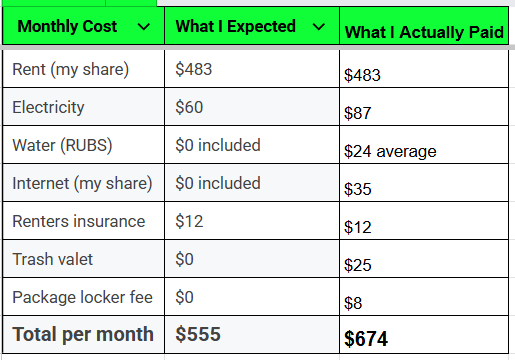
That is $119 more per month than I had planned for. Over a full year that is $1,428 in costs I had not budgeted for going in. For a grad student on a stipend that was a real problem that took me a few months to adjust to.
What Sarah Did That I Should Have Done
About two weeks before she moved in, Sarah called the leasing office and asked them one specific question. She asked: besides rent, what will show up on my monthly statement?
She told me they gave her a pretty complete list over the phone. She just did not write it all down carefully enough to catch the package locker fee. But she knew about the trash valet and the RUBS billing in advance because she asked that one question directly.
I did not ask that question. I read the lease and assumed everything important would be clear. It was not.
That one phone call is what I would tell every first-time renter to make before they sign anything. Do not ask what is included in rent. Ask what will show up on your monthly bill besides rent. Those are two very different questions and the second one gets you much more useful information.
FAQ
What costs are usually not included in Austin apartment rent?
Electricity is almost always separate. Internet is usually separate. Water and trash are sometimes included and sometimes not, and if they use RUBS billing your water cost will vary every month. Some buildings also add trash valet fees, amenity fees, and package locker charges on top of rent.
What is RUBS billing and how does it affect me?
RUBS stands for Ratio Utility Billing System. Instead of measuring how much water your specific unit uses, the building splits the total water bill for the whole complex among all tenants based on unit size or number of occupants. Your bill goes up or down based on what the whole building uses, not just you.
What is a trash valet fee?
It is a monthly charge some apartment complexes add for a service that collects a bag of trash from outside your door a few nights a week. In many buildings this is not optional. You pay for it whether you use it or not. Usually between $20 and $35 a month.
How do I find out all the monthly costs before I sign a lease?
Call the leasing office before you sign and ask specifically: besides rent, what else will show up on my monthly statement? Write down everything they say. Then read the lease looking for each item they mentioned. If something in the lease was not on their list, ask about it.
Is renters insurance a monthly cost I have to keep paying?
Yes. Most leases that require renters insurance require you to maintain it continuously for the full lease term. If you cancel it and the landlord finds out, some leases allow them to charge you for their own coverage at a much higher rate. Budget it as a permanent monthly expense.
Can I opt out of trash valet or other add-on services?
Usually not if they are written into the lease as mandatory charges. Some buildings do allow opt-outs for certain amenities. Ask specifically before you sign whether each add-on charge is optional or mandatory.
What was the biggest hidden cost surprise for first-time renters in Austin?
From what I have seen and heard from people I know, electricity is usually the biggest surprise, especially in Austin summers when the AC runs constantly. Bills of $120 to $180 a month in July and August are not unusual for a one or two-bedroom apartment. Always ask the leasing office for average utility costs by season before you commit.