I had been living in my Austin apartment for about a year and a half. Things were fine. I liked the place. I was not thinking about moving at all. Then one day in February 2022 an email arrived from my property management company with a lease renewal offer. The new rent was $400 more than what I was paying. I had 30 days to decide if I wanted to stay or find somewhere else. I did not know if this was legal. I did not know what to do. I just sat there reading that email over and over. This is the full story of what happened and what I learned from it.
It was a regular Tuesday evening. I remember I had just gotten back from the gym and was making dinner when my phone buzzed with the email notification.
I opened it thinking it was something routine. A maintenance update maybe, or a reminder about parking rules. The subject line said Lease Renewal Notice and I figured I would just sign whatever form they sent and move on.
Then I saw the new monthly rent number and I just stopped what I was doing.
I put down what I was cooking and read the whole email again slowly. The math was right there in plain text. We were paying $1,450 a month for the three-bedroom. The new offer was $1,850. That is $400 more every single month for the exact same apartment. Same walls. Same kitchen. Same parking spot that always had a puddle after rain. Nothing new. Just a higher number.
I texted Jake immediately. He replied in about two minutes saying he had gotten the same email and was already looking up whether this was even allowed.
It was a weird feeling, honestly. Not panic exactly. More like the floor had shifted slightly under me and I was trying to figure out if I was still standing on solid ground.
How Much the Increase Actually Was
I want to be specific here because the numbers tell the real story.
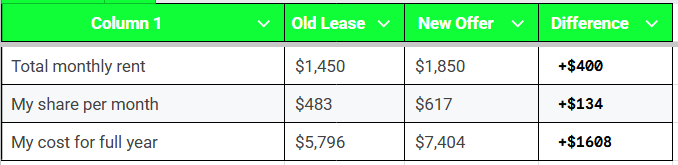
When we moved in during August 2020, the total rent was $1,450 a month split three ways. My share came out to roughly $483. The new offer was $1,850 total, which meant my share would go up to around $617 a month.
That is $134 more coming out of my pocket every single month. And I was a grad student at the time. My stipend had not gone up $134 a month. My groceries were also getting more expensive. My gas was more expensive. Everything was going up at the same time and now my rent wanted to join the party too.


Here is how the numbers actually looked when I wrote them down that night:
That last number is what really got me. Over a full year I would be paying $1,608 more. For the same apartment I had been living in for 18 months already.
Was Any of This Even Legal
Jake and I both spent that evening reading about Texas rental laws. I honestly expected to find something that said landlords could not raise rent by this much in one go. Some kind of cap or limit.
There was nothing like that.
Texas does not have rent control anywhere in the state. Austin tried to pass some tenant protections over the years but Texas state law blocks cities from controlling rent prices. So a landlord in Austin can legally raise your rent by any amount they want at the end of your lease. There is no percentage cap. There is no maximum increase allowed. As long as your current lease has ended, they can charge whatever the market will support.
The only real protection you have is your signed lease. While you are inside your lease term, the rent is locked. The landlord cannot change it mid-lease. But the moment that lease expires, you are negotiating from scratch.
Our lease ended in May 2022. The email came in February giving us 30 days to say yes or no to the new price. Thirty days to figure out whether we could afford to stay or needed to pack up and find somewhere else. In a city where every available apartment was also getting more expensive at exactly the same time.
What I Actually Did About It
I did not just accept it and I did not panic. I made myself slow down and do three things before I responded to anyone.
The first thing I did was spend two evenings checking what other apartments in our area were actually renting for right then. I went through Zillow, Apartments.com, and a couple of other sites looking at three-bedrooms near campus with similar square footage. What I found was genuinely uncomfortable to admit. Most comparable places were listing between $1,900 and $2,100 a month. Our new offer of $1,850 was actually at the lower end of what the market was doing at that moment.
That hurt to see. But it was important information. It meant our landlord was not being greedy beyond what the market was doing. She was just adjusting to what other landlords were already charging.
The second thing I did was sit down with Jake and run the real numbers on what moving would actually cost us. Not just the new rent somewhere else. The full picture. Application fees for each place we applied to. A new security deposit. Moving truck rental. Time off work. New utility setup costs. We estimated that switching apartments would cost each of us somewhere between $800 and $1,000 upfront even if we somehow found a cheaper place. And based on what I had just seen on Zillow, finding something cheaper was not guaranteed at all.
The third thing I did was email the landlord. I kept it simple and polite. I told her we had been good tenants for 18 months, that we always paid rent on time and never caused any problems, and I just asked if there was any flexibility on the renewal price. I did not threaten to leave. I did not complain about the increase. I just asked one clear question in a respectful way.
She replied two days later and came back at $1,800. A $50 reduction from the original offer.
Honestly it was not a huge win. But it was something. And it cost me nothing except five minutes to write a polite email. That taught me that asking is always worth it even when you think the answer will be no.
We signed at $1,800.
Why Austin Rents Exploded in 2022
This did not happen randomly and it is worth understanding why because it will help you recognize when something similar is coming.
Between 2020 and 2023 Austin grew faster than almost any other major American city. Remote work became normal during the pandemic and a huge number of people from California, New York, Seattle, and other expensive places decided to move to Austin. They could work from their laptop anywhere so they moved somewhere with lower taxes, warmer weather, and what used to be a lower cost of living.
The problem is that all those people needed somewhere to live. The number of available apartments did not grow nearly as fast as the number of people looking for them. When more people are competing for the same number of units, landlords can charge more. That is just how it works.
My landlord was not doing anything unusual. She was doing what every other landlord in Austin was doing at the same time. But for people like me who were already here on fixed stipends or entry level salaries, a $400 rent increase was not an abstract market force. It was a very concrete problem that arrived in my inbox on a Tuesday evening while I was trying to make dinner.
I knew people who had to leave Austin entirely during that period because of rent increases. People who had lived there for three or four years. They simply could not make the numbers work anymore. That felt wrong to me even if it was technically legal.
What to Do When Your Rent Goes Up at Renewal
If this happens to you, here is what I would do based on what I actually went through.
Check the market first before you do anything else. Look at what similar apartments in your specific neighborhood are renting for right now. That number tells you whether your landlord is asking for something reasonable or something way above market. It also tells you how much negotiating power you actually have.
Ask about a longer lease. Some landlords will give you a better monthly price if you commit to 18 months or 24 months instead of 12. They value not having to find a new tenant. Offer them stability in exchange for a lower increase.
Negotiate in writing by email rather than by phone. Email creates a record of the conversation. Be polite, be specific, and just ask directly if there is flexibility. Reference how long you have been there and how reliably you have paid. Keep it short.
Add up the real cost of moving before you decide to leave. A lot of people say they will just move somewhere cheaper and then realize that moving itself costs money they had not counted on. Calculate the full picture before you make that call.
Give yourself the full notice period to decide. Do not sign the renewal the day it arrives. Read every line. Check if any other terms changed beyond the rent. Ask any questions you have. The landlord wants you to stay because finding a new tenant costs them money too. You have a little more leverage than the email might make you feel.
FAQ
Can a landlord in Texas raise rent by any amount at renewal?
Yes. Texas has no rent control laws anywhere in the state. A landlord can raise rent by any amount when your lease ends. Your current signed lease protects you while it is active but once it expires they can set any new price they want.
How much notice does a landlord have to give before raising rent in Texas?
Texas law does not set a specific required notice period for rent increases at renewal. Most landlords give 30 to 60 days before the lease end date but check your lease itself because it may say something specific about renewal terms.
Can I refuse a rent increase?
You can refuse to sign the new lease at the higher price. But that means you need to move out when your current lease ends. You cannot stay at the old rent if the landlord is not offering it anymore.
Is it worth trying to negotiate a rent increase?
Always try. Be polite and keep it short. Reference your payment history and how long you have been there. My landlord dropped $50 off just because I sent one respectful email. It takes five minutes and the worst answer is no.
Why did Austin rents go up so much in 2022?
A large wave of remote workers and people relocating from expensive cities moved to Austin between 2020 and 2023. More people competing for the same number of apartments pushed prices up fast across the whole city.
Should I move if my rent goes up a lot at renewal?
Calculate the full cost of moving first. Application fees, new deposit, moving truck, and time off work add up fast. Sometimes staying at a higher rent is still cheaper than moving in the short term, especially if comparable apartments nearby are also expensive.
What if I just stop paying and use the deposit for last month’s rent?
Do not do this. Landlords almost never agree to it and if you do it without their permission you are breaking your lease. That can result in penalties, a negative rental history, and make it harder to rent anywhere else in the future.