Nobody told me there was a rule about how much of your paycheck should go to rent. I just picked an apartment I liked and signed. Then every month felt tight and I could not figure out why. It took me almost two years to realise I was spending too much on rent and not leaving enough money for everything else. Once I understood the rule, my whole budget made more sense. This post explains that rule in plain words and how to figure out the right number for you.
How much of your pay goes to rent right now?
I mean actually stop and think about it. Not what you think it should be. What it actually is.
I did not know my own number for almost two years. I just paid rent every month and hoped the rest of my money would stretch far enough. Sometimes it did. Sometimes it really did not. I kept thinking I was just bad at saving money. Turns out, I was spending too much on rent from the very start and the rest of my budget never had a fair chance.
The Rule Most People Do Not Know About
There is a simple rule that money people talk about a lot. It is called the 30 percent rule.
It says your rent should not be more than 30 percent of the money you bring home every month. That is the money after taxes, not before. The actual amount that lands in your bank account.
So if you bring home $2,000 a month, 30 percent of that is $600. That is how much your rent should be at most.
If you bring home $3,000 a month, 30 percent is $900.
That is it. That is the whole rule.
Now here is the thing. That rule is old. It was made a long time ago when rent was cheaper and life cost less. A lot of people today, especially in cities like Austin, end up spending closer to 40 or even 50 percent of their pay on rent. Does that mean they are doing something wrong? Not always. But it does mean there is less money left for everything else, and that is where people get into trouble.
What I Was Actually Spending
When I first moved to Austin in August 2020, I was a grad student at UT. My monthly money from my university program came out to about $1,950 after taxes.
My share of rent in the three-bedroom apartment I shared with Jake and Marcus, two guys I had connected with through a UT student group, was $483 a month.
So let me work this out. $483 out of $1,950. That is about 25 percent. Actually not bad. Under 30 percent. By the rule, I was fine.
Except I was not fine. And it took me a while to understand why.


The Part Nobody Tells You About
The 30 percent rule only counts rent. Just rent. Not the other things that show up on your bill every month because of where you live.
My actual monthly housing costs were not $483. They were closer to $620 when you added everything else. Electricity was around $75 my share. Internet was $35 my share. Renters insurance was $12. The building had a trash pickup fee that I had not noticed in my lease until the first bill arrived, that was $28 split three ways so about $9 my share.
I write about all those surprise costs in detail in my hidden monthly costs post, but the short version is that rent and housing cost are two different numbers and most people only track rent.
So my real number was $620 out of $1,950. That is about 32 percent. Still close to the rule, but higher than I thought. And on a tight grad student budget, that extra $137 above my rent number made a real difference every month.
When It Got Worse
The hard part came in spring 2022.
My landlord raised our rent by $400 a month total at lease renewal. My share went up by about $134. I wrote the full story of that in my rent increase post because it was a big moment for me.
Suddenly my rent share was $617. Add the same utilities and fees and my total housing cost was now over $750 a month.
Out of my $1,950 take-home, that was 38 percent going just to housing.
I had not gotten a raise. My food costs had gone up that year too. Everything was squeezing at once and I had no real cushion because I had never built one properly.
Let me show you what my money looked like that year:
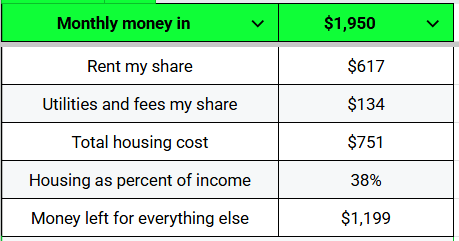
That $1,199 sounds okay until you take out food, phone, health insurance, transport, and anything unexpected. There was almost nothing left to save. Some months I saved nothing at all.
What the Rule Should Actually Be for You
Here is what I think now, after living through all of this.
The 30 percent rule is a good starting point. But the number that actually matters for you depends on where you live and what your life costs.
In Austin, rent is not cheap. A lot of people here spend 35 to 40 percent on housing, especially in the first few years. That is just the reality of this city right now. The key is to know your number before you sign a lease, not after.
Here is how to figure out your number in a few steps.
First, write down the money you actually bring home each month after taxes.
Second, look at apartments and find the total monthly cost, not just rent. Ask the leasing office what else shows up on the monthly bill. I explain exactly how to do that in my hidden monthly costs post.
Wait, I already linked that post above. So instead let me point you to the grad student budget post where I break down exactly how I tracked every dollar during my first year, which is useful if you are new to budgeting your own money for the first time.
Third, divide the total housing cost by your take-home pay. Multiply by 100. That is your percentage.
If it is under 30, you are in a comfortable spot.
If it is between 30 and 40, you can make it work but you need to be careful with the rest of your spending and build up some savings as a cushion.
If it is over 40, you will feel it every month. Not impossible, but tight. You will have very little room for surprises.
What I Would Do Differently
I would have done this math before I signed my first lease, not two years after moving in.
I would have asked the leasing office for the real monthly total, not just the rent number. And I would have checked what 30 percent of my take-home pay was and compared it to that total before I ever picked up a pen to sign anything.
It is not a complicated calculation. It takes five minutes. But nobody told me to do it and I did not think to ask. So I spent two years feeling financially tight without understanding why, until I finally sat down one evening and worked it out.
Do not wait two years like I did.
FAQ
What is the 30 percent rule for rent?
It says your rent should not be more than 30 percent of the money you bring home each month after taxes. So if you bring home $2,000, your rent should ideally be $600 or less. It is a rough guide, not a law, but it is a useful place to start.
Is 30 percent still realistic in Austin?
Honestly, it is getting harder. Austin rents have gone up a lot in the past few years. Many people here spend closer to 35 or 40 percent on housing. Knowing that going in helps you plan better rather than getting surprised later.
Should I count just rent or everything?
Everything. Rent plus utilities plus any fees that come with the apartment. That full number is your real housing cost and that is what should stay under 30 to 35 percent of your take-home pay. Counting only rent and ignoring the rest is what tripped me up for two years.
What if my rent is already over 40 percent of my income?
Then your budget is tight and you know it. A few things that help: get a roommate to split the cost, look at cheaper areas of Austin where rent is lower, or find ways to bring in a little more money. There is no magic fix but knowing the number at least means you can make real choices about it instead of just wondering why every month feels hard.
How do I figure out my own percentage?
Take your total monthly housing cost, divide it by your monthly take-home pay, then multiply by 100. That gives you your percentage. Do this before you sign any lease so you know what you are walking into, not after you have already moved in.
Does the rule change if I have a roommate?
Yes, in a good way. When you split rent with one or two other people, your share goes down and your percentage of income going to housing usually drops too. That is one of the real financial benefits of having roommates, especially in an expensive city like Austin. I shared an apartment with Jake and Marcus for nearly two years and that shared cost is a big part of how I made my grad student budget work at all.