I got my first real tech job in June 2022 and I thought everything would finally feel easy. I had been on a student budget for two years and now I had a real salary coming in. But my spending went up almost as fast as my income did, and for the first few months I felt just as tight as I had as a grad student. This post is about what actually changed in my budget, what I got wrong, and what I wish I had done with that first paycheck instead of what I did.
I was staring at my bank app on a Thursday afternoon in late June 2022.
My first real paycheck had just landed. Not a stipend. Not part-time hours. A real salary, direct deposit, the kind that comes with tax taken out already and still leaves you with more than you have ever seen hit your account at one time.
I remember the exact number. I remember closing the app and opening it again just to check it was still there.
Then I started doing math in my head. Rent. Food. Utilities. And then I started thinking about all the things I had told myself I would buy once I had a real job. The better laptop. The standing desk. The actual nice headphones instead of the $12 ones from the drugstore.
By the time I was done with that mental list the paycheck already felt smaller.
What My Budget Looked Like as a Grad Student
For context, my two years as a grad student at UT Austin were tight in a way that shaped every money habit I had. I was splitting a three-bedroom near campus with two roommates, Jake, who was American and knew the rental system well, and Marcus, who was fine to live with but not always great about paying bills on time.
My share of rent was $600 a month. Utilities split three ways came to maybe $70 for my share. Food was around $180 a month because I cooked almost everything at home and bought the cheapest stuff that tasted okay. I had a small stipend from my program that covered the basics but not much more.
Total monthly spending: somewhere around $950 to $1,000.
I had figured out how to live inside that number. I knew which grocery store had the best prices. I knew not to eat out more than once or twice a week. I knew how to make a bag of rice last. It was not fun but it was manageable and I had zero financial stress because there were no decisions to make. There was only one way to spend and that was the cheap way.
If you want to see what that grad student budget looks like in full detail, I wrote about it in my grad student budget post for first year in Austin, which covers exactly how I kept costs down during those two years.
What Changed the Day the Job Started
June 2022. New job, new salary, and about three weeks later, a new apartment.
I moved out of the shared three-bedroom and into my own one-bedroom on East Sixth Street. Rent jumped from $600 a month, my share of the shared place, to $1,450 a month on my own. That is an $850 jump in rent alone.
People told me I should stay with roommates a little longer. I did not listen. I had just gotten a real job and I wanted my own space. Looking back, that one decision probably cost me close to $10,000 over the next year compared to if I had stayed in a shared place. I covered the full math on that in my post comparing living alone vs having a roommate in Austin.
But rent was not the only thing that jumped.
The Full Budget Comparison
Here is what my actual monthly spending looked like before and after the job, once things settled down a few months in.
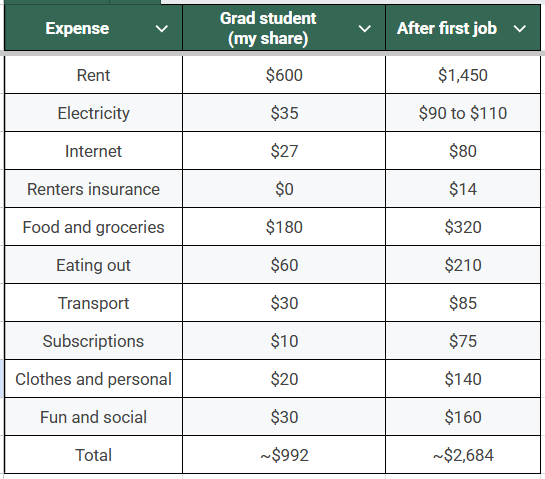
My income went up by a lot. My spending went up by even more in percentage terms when I looked at the categories outside rent. Food, eating out, subscriptions, clothes, going out with coworkers, all of it crept up without me making any real decision about it. It just happened.
There is a name for this. Lifestyle creep. It means your spending grows along with your income without you really choosing to let it. You are not buying crazy things. You are just buying slightly better versions of everything, slightly more often, and it adds up faster than you expect.
The Part That Surprised Me Most
I thought rent would be the hard part. And it was hard, but I had planned for it. What I had not planned for was how much more I would spend on food.
As a student I cooked everything. As someone with a job and longer work days, I started ordering food more. Not every night, maybe twice a week at first. But twice a week at $18 a delivery plus tip adds up to about $150 a month before I even count the meals I ate out with coworkers.
My coworker Sarah, who had been renting in Austin for a few years before I started at the company and knew what the first year of full-time work does to a budget, warned me about this in my second week. She said the eating out thing sneaks up on everyone. She was right.
I also started spending more on things I told myself were for work. A better laptop bag. A nicer keyboard. A lamp for the desk at home. Each thing was $40 to $80 on its own. None of them felt like a big deal. Together across three months they added up to close to $400 that I had not counted anywhere in my budget.
How Much of My Income Was Actually Going to Rent
Here is a number I did not look at closely enough in those first months.
My take-home pay after tax was around $4,200 a month. Rent alone was $1,450. That is about 34.5 percent of my take-home going to just rent.
Most advice says to keep rent under 30 percent of what you bring home. I was already over that before I paid for food or anything else. I had checked what the right number should be in my post on how much income should go to rent, but I had checked it after I signed the lease, not before. Classic timing.
At 34.5 percent rent I was not in trouble, but I had less room for savings than I thought I would. Every surprise cost, a broken phone, a doctor visit, a car repair, hit harder than it would have if I had kept rent lower.
What I Would Do Differently
I would stay with a roommate for at least six more months after starting the job. I wanted my own space badly after two years of sharing, and I understand that feeling, but the money difference was real and I did not need to be alone that urgently.
I would also make a written budget on day one of the job, not three months in when I noticed things felt tight. I had no budget those first months, just a general sense that I had more money than before, which turned out to be a terrible guide for actual spending.
The other thing I would do is build my emergency fund from the very first paycheck. I wrote about how to do that even when rent takes most of what you make in my post on building an emergency fund when rent is high. I did not start that until about eight months into the job and I wish I had started on day one.


The Thing Nobody Tells You About Getting More Money
More money does not automatically mean less stress about money. That sounds obvious when you say it out loud but it really does not feel obvious when you are going from a student stipend to a real salary.
What actually happened was that my decisions got harder, not easier. As a student there was one answer to every money question and that answer was “no, I cannot afford that.” With a salary I had to actually decide. And I was not good at deciding yet.
Knowing what your real monthly costs look like before you start spending is the most useful thing you can do. My post on hidden monthly costs in an Austin apartment covers all the things that do not show up obviously in the rent number but hit your account every single month. And if you want to understand what all the fees in your lease actually mean before you sign, my hidden fees post breaks those down too.
I am not saying I regret getting the job or moving into my own place. I do not. But I spent about a year figuring out the budget I could have figured out in the first month if I had just sat down and done the math properly before I started spending.
FAQ
How much should I budget for rent after my first real job?
Try to keep it under 30 percent of what you actually bring home after tax, not your salary before tax. So if your take-home is $4,000 a month, aim for rent under $1,200. I went to 34 percent and it was manageable but tight. Going higher than that starts to squeeze everything else in a way that is hard to recover from month to month.
Why does money still feel tight even after a salary increase?
Because spending tends to grow with income and it does it quietly. You are not making one big expensive decision. You are making fifty small ones, a nicer lunch here, a subscription there, an Uber instead of waiting for the bus. None of them feel like anything on their own. Together they can eat an entire raise without you noticing until you check your bank account and wonder where it went.
Should I move into my own place right after getting my first job?
Probably not right away. I did and I do not regret the experience but the cost difference between living alone and splitting with even one roommate is real money, somewhere around $500 to $900 a month depending on the place. That gap over a year is a vacation, a laptop, or a solid emergency fund. Give yourself a few months at the job first, see what the budget actually looks like, then decide.
What should I do with my first paycheck?
Before you spend anything fun, figure out your actual monthly costs. Write them all down. Rent, utilities, food, transport, everything. Then see what is left. Whatever is left, put at least some of it somewhere separate before you have a chance to spend it. Even $100 into a savings account on day one builds a habit that will matter later, more than whatever you would have bought with it.
Did having a budget actually help or is it just advice people give?
For me it helped a lot once I actually made one, which took me about eight months longer than it should have. Before I had a written budget I was just hoping the numbers worked. After I had one I knew they worked or I knew exactly where the problem was. Hoping is much more stressful than knowing even when the numbers are not perfect.
What is lifestyle creep and how do I stop it?
Lifestyle creep is when your spending quietly grows every time your income grows, without you making a real choice about it. The way to slow it down is to decide in advance what you will do with extra money before it arrives. Before your first paycheck hits, decide that a certain amount goes to savings automatically. Then spend the rest however you want. That one decision made in advance is worth more than a hundred small decisions made in the moment when you are tired and hungry and just want the nicer option.