When I moved into my first solo apartment in Austin in September 2022, I had budgeted for rent, utilities, and food. I had not budgeted for the dozen other things that quietly showed up in my first three months and drained my account faster than I expected. Sarah, a coworker at my Austin tech startup who had been renting solo in Austin for years before me, told me later that everyone gets surprised the first time. This post is every surprise I hit, how much it actually cost, and what to put in your budget before you go solo so you are not caught off guard the way I was.
“Nobody tells you about the toilet paper math,” Sarah said.
Sarah is a coworker at the Austin tech startup where I started working in June 2022. She had been renting on her own in Austin for a few years before I even arrived in the city, which meant she had already been through everything I was about to go through.
I had just moved into my one-bedroom on East Sixth Street and I was complaining to her at lunch about how September had felt financially tighter than I expected. She nodded like she had heard this exact conversation before, because she had, probably from every person who goes solo for the first time.
She said when you live with roommates, someone always has toilet paper. Someone always has dish soap. Someone always has a spare roll of paper towels. When you live alone, that someone is always you, every single time, and you do not notice how much that adds up until you are buying everything yourself for a few months in a row.
She was right. But toilet paper was only the beginning.
The Supplies Problem
In my shared three-bedroom near UT Austin, household supplies just appeared. Jake, my first roommate who was American and knew how shared living worked, would grab dish soap when he was at the store. Marcus, our third roommate, occasionally picked up cleaning spray. I bought things sometimes too. It evened out without anyone keeping score.
Living alone, I buy everything. Every time. The dish soap, the sponges, the trash bags, the bathroom cleaner, the glass spray, the laundry detergent, the dryer sheets, the toilet paper, the paper towels, the hand soap, all of it.
In my first month alone I spent about $95 on household supplies. That felt high. Then I tracked it for the next two months and it averaged around $40 to $55 a month once I was stocked up on the big things. Still more than I ever spent on supplies when I was splitting costs three ways.
This is not a huge number but it is one that almost nobody puts in their solo living budget because it feels too small to count. Over a year it is $480 to $660. That is real money that I had simply not planned for.
If you want a full picture of what monthly costs look like beyond just rent, my post on hidden monthly costs in an Austin apartment covers all the lines that do not show up obviously when you are planning a budget.
The Electricity Surprise
I knew electricity would cost more living alone than my share of a split bill had. What I did not know was how much more, especially in Austin in September.
My share of the electric bill in the shared apartment was around $35 a month. My first bill in the solo one-bedroom was $118.
That is not a typo. $118 for one month. Just me in a one-bedroom.
The reason is AC. Austin summers run hot well into September and sometimes October and a one-bedroom AC running all day costs real money. The US Energy Information Administration notes that Texas has some of the highest summer electricity demand of any state, which you feel directly in your bill when you are footing it alone.
By November my bill dropped to around $52. So the range in a solo Austin apartment is roughly $50 in cooler months to $120 in peak summer, and that swing caught me completely off guard in September when I was already tight from moving costs.
My post on how to estimate utility costs before signing a lease has the numbers to look at before you commit to a place, so you are not surprised the way I was on that first bill.
Furniture and Setup Costs I Did Not Budget For
When I left the shared apartment, some things stayed behind because they belonged to Jake or Marcus. The coffee table was Jake’s. One of the kitchen chairs was Marcus’s. The shared TV stand was Jake’s.
I knew this when I moved out. I did not fully think through what replacing those things would cost.
In my first six weeks in the solo apartment I spent
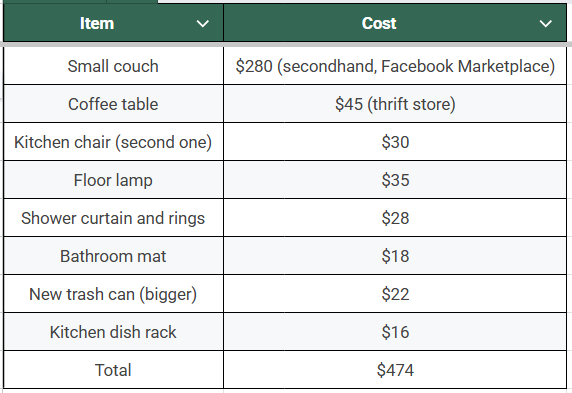
None of these felt like a big purchase. The couch was the biggest and I went secondhand to keep it reasonable. But $474 in setup costs on top of a security deposit and first month’s rent in the same period hit harder than I expected.
The Consumer Financial Protection Bureau recommends keeping three to six months of expenses saved before a major life change like moving solo, which I did not have at the time. That gap between what I had saved and what the first two months actually cost me was stressful in a way I could have avoided with better planning.
The Food Waste Problem
Sarah warned me about this one too and I still did not avoid it.
When you live alone you cook for one person. But most food at the grocery store is packaged for more than one person. A bag of spinach. A bunch of bananas. A loaf of bread. A pack of chicken. You buy it, you use some of it, and the rest sits there until it goes bad.
In my first month living alone I threw away food I am embarrassed to admit. Half a bag of spinach that went slimy. Three bananas that went too soft before I got to them. Most of a loaf of bread because I only eat two or three slices a week. A container of yogurt I opened once and forgot about.
I was wasting roughly $35 to $50 a month in food just from buying too much. That is close to $500 a year thrown directly in the trash.
The fix I eventually landed on was buying for three or four days at a time instead of a full week. More trips, less waste. It sounds like more work but it actually takes the same amount of time and costs noticeably less per month.
The Internet Bill Jump
In the shared apartment, we split a $80 internet plan three ways. My share was about $27.
Living alone I needed my own plan. The cheapest plan I could find that had decent speed was $65 a month. That is more than double what I had been paying.
I know $65 is not a shocking number. But it is one of those costs that feels invisible until you are paying it alone and you realise that your share of a shared bill was a very different thing from a full solo bill. The same logic applies to electricity, renters insurance, and everything else that used to be divided.
If you are thinking about whether living solo is worth the full cost difference versus staying with a roommate, I compared those exact numbers in my post on living alone vs having a roommate in Austin. The gap is bigger than most people expect when you add all the split costs back up.
The Maintenance Calls I Had to Make Myself
This one sounds small but it is real.
In a shared apartment, someone else sometimes noticed things and reported them. Jake was good at spotting problems and following up with the building. When the kitchen tap dripped, Jake called. When the hallway light near our door went out, Jake called.
Living alone, every call is your call. Every maintenance request is yours to file. Every follow-up when nothing happens is yours to chase.
This is not a money cost exactly but it takes time and energy and the first time your AC unit makes a strange noise at 9pm and you have to figure out who to call and what to say, it feels more overwhelming than it should. Knowing your renter rights helps a lot in those moments. My post on renter rights for your first lease explains what your landlord is actually required to fix and how fast, which gives you confidence when you make those calls.
The Texas State Law Library also has a plain-language guide to tenant rights at texaslawhelp.org which I found genuinely useful when I was not sure if something was my responsibility or the landlord’s.
The Month Everything Hit at Once
October 2022 was the month I really felt it.
My electricity bill came in at $97. My internet was $65. I had just bought the floor lamp and the kitchen rack. I had a dentist appointment I had been putting off and finally went, which cost $180 after my insurance covered its part. And my building sent a notice about a $50 fee for a parking permit I had not realized I needed even though I did not own a car, so I had to go dispute it and get it removed, which took two weeks of back and forth.
None of those things on their own would have been a problem. All of them in one month, on top of $1,450 rent, added up to a month where I felt like I was treading water.
Sarah, when I told her about it, said welcome to living alone. She was not being mean about it. She just meant that this is the month everyone has in their first solo year, when everything lands at the same time and you realise your budget was built for the average month, not the hard one.
The way to prepare for that month is an emergency fund, even a small one. My post on building an emergency fund when rent is high covers how to start that even when money already feels tight.
What to Budget That Nobody Tells You About
Here is the simple version of what I wish someone had handed me before I moved in.
Add these to your solo budget before you start:
Monthly supplies budget of at least $45 to $60. Electricity range from $50 in winter to $120 in peak Austin summer. Internet at full solo price, not split price. A setup fund of at least $300 to $500 for the things you will discover you need in the first month. A food waste buffer until you figure out your shopping rhythm. And an emergency fund contribution from day one, even if it is just $25 a week.
The hidden costs of living alone are not dramatic individually. They are just consistent and they stack. Knowing they are coming means you can plan for them instead of being surprised by them the way I was.


FAQ
What is the biggest surprise cost when you first live alone?
For most people it is utilities, specifically electricity in Austin where summer bills can hit $100 to $120 for a single person in a one-bedroom. In a shared place your portion feels manageable. Alone, the full bill is yours and it is higher than people expect, especially in the first September or August.
How much should I budget for household supplies when living alone?
Around $45 to $60 a month once you are past the first stocked-up month. Your first month might be higher, closer to $80 to $100, because you are buying everything from scratch. After that it settles into a steady monthly cost that most budget guides completely leave out.
Is living alone actually worth the extra cost?
That depends entirely on what you value. The quiet, the privacy, the not having to coordinate with anyone, those things are real and worth something. But the cost difference between solo and shared living in Austin is somewhere between $500 and $900 a month when you count everything, not just rent. That is the honest number to weigh against the benefits.
How do I stop wasting so much food when cooking for one?
Shop for three to four days at a time instead of a full week. Buy smaller quantities even if the per-unit price is slightly higher, because throwing away half a bag of spinach is always more expensive than buying the smaller bag. Frozen vegetables are also genuinely useful for solo cooking because they do not go bad before you get to them.
What should I set up on day one of a solo apartment?
Electricity in your name, internet booked even if installation is a week away, renters insurance activated, and a photo walkthrough of the whole apartment sent to yourself by email. Those four things protect you from the most common early problems. My post on what to do in your first week in a new apartment goes through the full list.
Why does everyone say the first month solo is the hardest?
Because it is the month when the setup costs, the supply costs, the utility surprises, and the learning curve all land at the same time. After that first month things calm down because you know what the bills actually look like and you have most of what you need. The first month is an outlier, it is just an expensive and stressful one.
Where can I find free help if I am struggling with renter costs in Austin?
The City of Austin has renter assistance programs and resources at austintexas.gov. The Texas Tenants’ Union at txtenants.org offers free advice for renters dealing with landlord issues or financial pressure. These are real resources that do not cost anything to use and are worth knowing about before you need them.