When I moved to Austin in August 2020, I had never bought groceries for myself before. Back home in India my mom handled all of it. In my first three-bedroom apartment near UT I shared with Jake, my American roommate who had lived on his own before and knew how grocery shopping worked, I wasted more food in my first month than I care to admit. This post is about what I got wrong, what I figured out slowly, and what a tight first-apartment grocery budget actually looks like in Austin when you are doing it for the first time.
Have you ever bought a full bag of onions when you only needed one?
I did that in September 2020. Bought a whole bag because it was cheaper per onion than buying them loose. Logical, right? Except I used two onions that month and the rest went soft and I threw them away. I saved maybe 40 cents per onion and wasted about eleven of them.
That was the month I realized I had absolutely no idea what I was doing at the grocery store.
What My Grocery Budget Looked Like at the Start
When I moved into the three-bedroom near UT Austin in August 2020, my total monthly budget for everything was tight. Rent was $600 for my share. Utilities were about $70 for my share. That left me with not much for everything else including food.
I had set aside about $200 a month for groceries. That felt like enough. Some months it was. A lot of months it was not, and the reason it was not enough had nothing to do with Austin prices being too high. It was because I was wasting a lot of what I bought.
Jake, who had rented and cooked for himself before and was calm and practical about most things, watched me unload my first grocery haul and just asked, are you cooking for a family? I had bought enough vegetables for probably eight people for a week. I was one person who barely knew how to cook.
The Stores I Used and What They Actually Cost
Austin has a lot of grocery options and the price difference between them is real. In 2020 I shopped at three different places at different times before figuring out what worked for my budget.
H-E-B was the best for everyday basics. It is a Texas grocery chain and the prices on things like rice, beans, eggs, chicken, and produce are genuinely lower than most other stores. If you are on a tight budget in Austin, H-E-B is where most of your shopping should happen. I did not figure this out until about my third month because I kept going to the closer store out of habit.
Whole Foods was near campus and I went there a few times in my first weeks because it felt like a nice thing to do. I spent $67 on one trip and came home with two bags. I did not go back for a long time after that.
Walmart was useful for dry goods, rice, lentils, oil, things that do not need to be fresh and where the price difference from H-E-B was a few more cents per item. Some months I split my shopping, H-E-B for fresh stuff and Walmart for the pantry staples.
According to the USDA’s monthly food cost reports, a single adult eating at home on a thrifty plan spends roughly $200 to $250 a month on food. You can see their current figures at fns.usda.gov. My $200 budget was at the low end of that but doable if I stopped wasting things.
What I Was Cooking in Those First Months
I want to be honest here because I think a lot of people new to cooking oversell how much they were making.
I made rice almost every day. I made dal, which is cooked lentils, because I knew how to make it from watching my mom and it was cheap and filling. I made eggs in a few different ways because eggs are one of the cheapest proteins you can buy. I made very simple vegetable dishes with whatever was cheapest that week.
That was basically it for the first two months. Rice, dal, eggs, simple vegetables. Not exciting but it kept my food costs down and I was not throwing away things I did not know how to cook.
Jake cooked more varied things and sometimes we would share a meal, which helped both of us stretch the food budget without planning it that way. He showed me how to make a basic pasta dish that cost maybe $2 per serving and took 20 minutes. That went into my rotation fast.
If you want to understand how food costs fit into the bigger picture of what first apartment life costs, my post on what first-time renters waste money on covers food waste as one of the biggest silent drains in that first year.
The Embarrassing Waste Phase
Here is the part I am not proud of.
In my first six weeks I threw away a lot of food. Not because I forgot about it exactly, more because I bought things I did not know how to use before they went bad.
I bought a head of cabbage because a recipe I saw online called for it. I used about a quarter of it. The rest sat in the fridge for two weeks and went soft.
I bought fresh ginger because I thought I would cook with it a lot. I used it once. The rest dried out.
I bought a big tub of Greek yogurt because I thought I would eat it for breakfast every morning. I had it twice. It expired.
I bought spinach three times in a row and threw most of it away three times in a row because I kept thinking this time I would actually use it and I did not.
My best rough guess is that I threw away between $30 and $45 of food in my first month. That is not a small number on a $200 budget. It is almost a quarter of what I had to spend, gone.
What Actually Fixed the Waste Problem
Two things helped more than anything else.
The first was buying for three or four days instead of a week. I started going to H-E-B twice a week instead of once. Smaller hauls, fresher food, almost nothing going bad before I got to it. The total I spent did not go up because I was buying less each trip.
The second was planning three meals before I went shopping instead of just buying things and figuring it out later. Not a fancy meal plan. Just three meals. I would think, this week I will make dal and rice, eggs and toast, and that pasta Jake showed me. Then I would write down exactly what I needed for those three things and buy only that plus the basics I always needed.
That second change cut my waste almost completely. I was not buying cabbage for a recipe I might make. I was buying exactly what I knew I would cook.
The Consumer Financial Protection Bureau has a simple guide on budgeting for everyday expenses including food at consumerfinance.gov, which helped me think about food spending as a fixed line in my budget rather than something I just hoped would work out.
What My Grocery Budget Looked Like Once I Got the Hang of It
By month four or five I had a rhythm. Here is roughly what I was spending and on what.
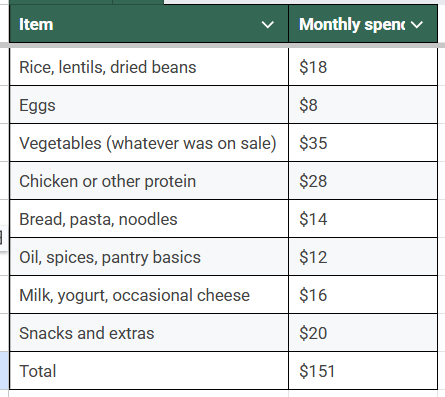
I came in under my $200 budget most months once I stopped wasting things. The difference, roughly $40 to $50 a month, I started putting toward my emergency fund, which at the time had nothing in it.
Eating Out and Where That Fit In
I was not perfect about eating in every meal. Nobody is.
Austin has a lot of cheap and good food options, especially near campus in 2020. There were food trucks on Guadalupe that did full meals for $7 to $9. There were a few Indian and South Asian places I went to when I was homesick for real food that was not my basic dal.
I gave myself a rough limit of $50 a month for eating out in those early months. Some months I hit it. Some months I went a little over. But having the number in my head helped me make different choices than I would have without it.
Jake used to say that eating out was fine as long as you counted it. The problem, he said, was people who told themselves they barely ate out and then spent $200 a month without realizing it because they never tracked it. He was right about that.
What I Would Tell Someone Moving Into Their First Austin Apartment
Shop at H-E-B. Start there and stay there for most things.
Plan three meals before you go to the store. Write down exactly what you need. Do not buy things you might use. Buy things you will use.
Buy for a few days at a time, not a full week, until you know your own rhythm. More trips sounds annoying but it saves real money in wasted food.
Give yourself a small eating out number and track it. Even $40 a month for a meal out here and there keeps you sane without blowing the budget.
And do not buy a whole bag of onions when you only need one. Trust me on that one.
If you want to see how grocery costs fit into a full first-year budget in Austin, my post on grad student budget for your first year in Austin breaks down every spending line from that period including food, rent, and utilities. And for a look at all the costs that come on top of rent every month, my post on hidden monthly costs in an Austin apartment is worth reading before you move in.


FAQ
How much should I budget for groceries in my first Austin apartment?
Around $150 to $200 a month for one person is doable if you shop at H-E-B, cook most of your meals at home, and do not waste much. Your first month might be higher while you figure out your rhythm. After that most people can stay in that range without feeling deprived.
Is H-E-B really that much cheaper than other stores in Austin?
For everyday basics like rice, eggs, chicken, and produce, yes it is noticeably cheaper than Whole Foods and usually a bit cheaper than Target for groceries too. It is not dramatically cheaper than Walmart on dry goods but the quality is better and the range is much wider. Most people renting in Austin on a budget end up at H-E-B for most of their shopping.
What are the cheapest filling foods to cook when you are on a tight budget?
Rice and lentils are at the top. Eggs are one of the cheapest proteins you can buy. Pasta with a simple sauce is cheap and quick. Chicken thighs are cheaper than chicken breast and taste better in most cooked dishes. Frozen vegetables cost less than fresh and last longer, which matters a lot when you are cooking for one and things go bad quickly.
How do I stop wasting so much food when I am new to cooking for myself?
Plan your meals before you shop, not after. Write down three or four specific meals you will make that week and buy only what those meals need. Stop buying things because they seem useful. Buy things because you have a plan for them. That one change cuts waste more than anything else.
Is it okay to eat out sometimes when you are on a tight budget?
Yes, just count it. Give yourself a number, even $40 or $50 a month, and track what you spend. The problem is not eating out once in a while. The problem is not knowing how much you are spending on it until the month is over and the money is gone.
What is the biggest grocery mistake first-time renters make?
Buying for a full week before they know their own cooking habits. You end up with food you do not use before it goes bad. Shop for a few days at a time until you know what you actually cook and eat regularly. Then you can start buying in slightly bigger amounts for the things you always use.
Where can I find help if food costs are becoming a real problem?
The Capital Area Food Bank in Austin provides free food assistance to people who need it at austinfoodbank.org. There is no shame in using it. It exists for exactly these situations and serves thousands of Austin residents every month including students and people in their first jobs.